We use cookies to personalise site content, social media features and to analyse our traffic. We also share information about your use of this site with our advertising and social media partners.
FEATURED
SPONSORED
VERIFIED
Mar 27 -
6 minutes, 39 seconds
-15.8K Views 11 Comments 0 Likes 0 Reviews
Nebraska has never seen anything like this. What started as a fire report on the afternoon of March 12, 2026, quickly turned into one of the most devastating natural disasters the state has ever witnessed.
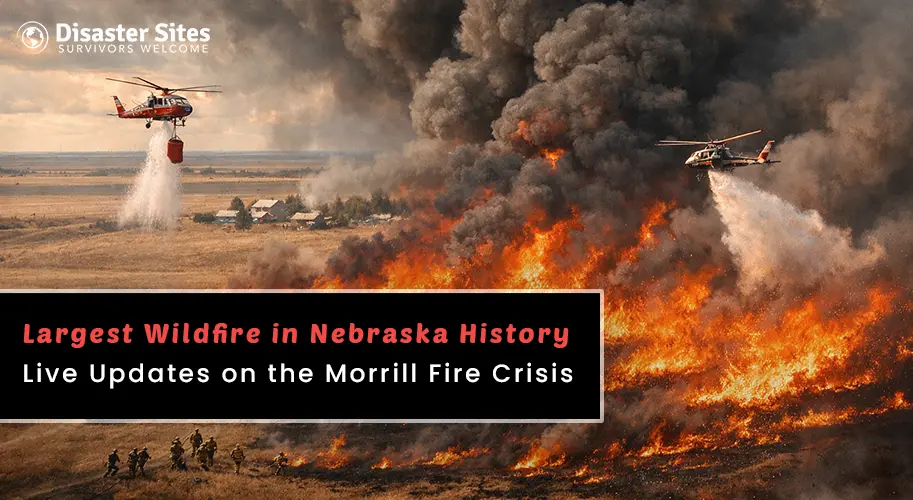
The Morrill Fire, a megafire burning across Keith, Arthur, Grant, Garden, and Morrill Counties, has scorched over 643,000 acres, making it the largest wildfire in Nebraska state history and the largest wildfire in the United States during the 2026 wildfire season.
This wasn't just a fast-moving fire. It was a perfect storm of dangerous conditions colliding with dry, vulnerable land, and communities caught in its path had very little time to react.
During the late afternoon of Thursday, March 12, 2026, a wildfire started in Morrill County, Nebraska. The fire was rapidly pushed to the east/southeast by immense high winds. In less than 12 hours, the fire had traveled approximately 70 miles.
The National Weather Service Storm Prediction Center had issued a Day 1 Fire Weather Outlook for March 12, highlighting an Extremely Critical risk for portions of western Nebraska and eastern Wyoming. Winds of 20–35 mph, humidity as low as 15–20%, and sparse vegetation created a high-impact, rapid fire spread environment.
Though the official cause remains undetermined, Governor Jim Pillen stated that it was "electrical in nature." Whatever the spark, the conditions were basically a tinderbox waiting to ignite.
To truly understand how massive this disaster is, the numbers speak for themselves:
The most heartbreaking part of this disaster is the human cost. The fire claimed the life a senior citizen from Arthur, who died while trying to escape the raging wildfire.
The fire caused evacuations for Lewellen and areas around Lake McConaughy, destroying numerous structures. Smoke spread widely, creating hazardous air quality across much of Nebraska, northern Colorado, and northwestern Kansas.
Governor Pillen called it "one of the worst natural disasters in Nebraska history," and given the scope of destruction, it's hard to argue otherwise.
The response to the Morrill Fire has been nothing short of massive. Air tankers arrived on scene early Friday morning, and agricultural irrigation systems were even activated in some areas to try to slow the fire's spread and protect structures.
Five twenty-person crews, one of which was the Nebraska National Guard's Air Guard Hand Crew, were constructing firelines with hand tools directly on the fire's edge and extinguishing hotspots. Four National Guard Black Hawk helicopters from Nebraska and Iowa were used to drop water on burning and smoldering vegetation.
Governor Pillen called on mayors of Omaha and Lincoln to provide additional personnel and equipment, and also reached out to neighboring states, including Iowa, to request help.
The tide has finally started to turn. The Morrill Fire is currently 98% contained. Crews are responding to smoke reports in the fire area and working to reduce the workload on volunteer firefighters.
As containment nears 100%, fire managers have begun demobilizing some equipment and personnel, with firefighters returning to their home units before potentially being sent to assist with wildfires in other parts of the country.
That said, the work is far from over. Much of the burned terrain is in areas not easily accessible by vehicles or on foot, and methodically extinguishing remaining heat sources along the perimeter is a time-consuming but critical phase of the suppression effort.
These wildfires are being driven by a powerful heat wave, with temperatures in the 80s°F combining with low humidity, high winds, and extreme drought. Research has shown that wildfires in the western U.S. are spreading more quickly as climate change leads to hotter, drier conditions, and globally the most extreme fires are twice as common as they were 20 years ago.
Nebraska isn't typically a state people associate with catastrophic wildfires, but the Morrill Fire has changed that perception forever. This is a warning that no region is immune.
The Morrill Fire is more than a statistic. It's a reminder of how quickly nature can overwhelm communities, infrastructure, and even entire landscapes. While the containment numbers are finally moving in the right direction, the recovery for ranchers, families, and ecosystems across western Nebraska will take months or years.
Visit Disaster Sites for more live updates and real insights on the Morrill Fire and other natural disasters unfolding around the world.

“To assist disaster survivors by providing a source for them to come together in time of need, to aid in the listing of events, information and other forms of assistance, and continuing support through the recovery process.”

Share this page with your family and friends.