We use cookies to personalise site content, social media features and to analyse our traffic. We also share information about your use of this site with our advertising and social media partners.
FEATURED
SPONSORED
VERIFIED
Jan 27 -
8 minutes, 28 seconds
-2K Views 15 Comments 0 Likes 0 Reviews
Disasters are now more frequent and more severe. Climate change is causing storms to become stronger, heat waves to become prolonged, precipitation events to become extreme, and rising water levels/lack of systems to expose our communities to disaster risks. The incredible growth of our urban centers means that there are greater populations being located in areas that are vulnerable to disasters. Disasters have severe implications, and sometimes they can be catastrophic. We know, in general, whether it is an earthquake, flood, wildfire, or pandemic, that time, or the quality of a response, saves lives.
Likely there is no greater opportunity for governments to have the crucial role in a disaster response than implementing effective disaster response plans where communities can mobilize resources, coordinate agencies, and protect people before, during, and after crises. An effective government-led disaster response system can not only lessen disaster losses, but can also allow for impacted communities to recover sooner.
This blog discusses the everyday actions governments can take, including investing in new technologies to help improve their disaster response systems. Governments can build resilient communities, and become better prepared to face the ongoing challenges of risks in the near future.
The best way to save lives during a disaster is to enable self action. This is why early warning systems are vital to disaster response, when we're giving people warnings before danger occurs, lives are saved. Unfortunately, these systems are slow, out dated, or too limited to get to everyone, in many areas of the world.
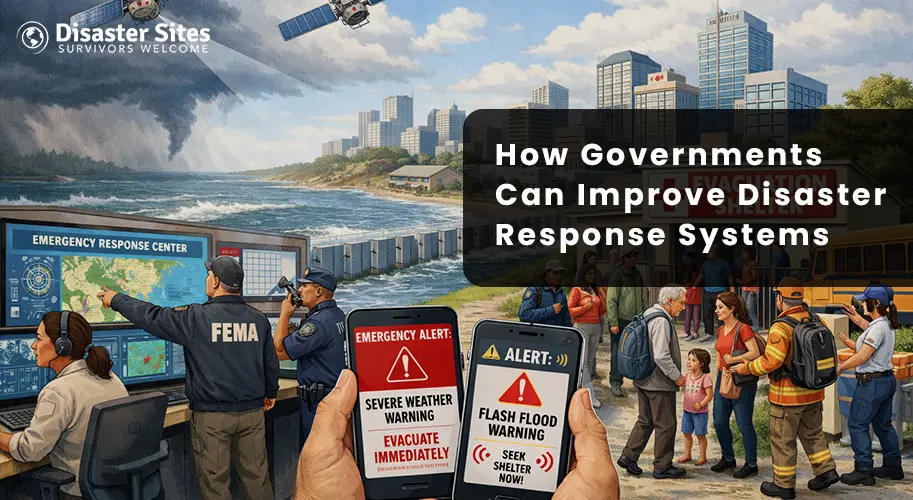
Governments can achieve leaps and bounds in improving early warning systems by investing in new technology in a substantial way. The capability of weather satellites, radar, and artificial intelligence has greatly improved the ability to predict storms, flooding or earthquakes. Mobile alerts, and text messages can be sent to potentially millions of people all at once, even in remote areas.
However, the presence of technology alone is not sufficient. With technology, governments must also work to ensure that people understand what action they should take when broadcasted alerts are issued. Public information campaigns, schooling, and community drill exercises are also very important to make alerts as effective as possible. Most importantly, if the public is well informed, they can react better, therefore, potentially reducing losses from the event.
To explore how myths and misconceptions weaken preparedness, see "Top 5 Myths About Natural Disasters – Debunked".
Infrastructure can mean the difference between chaotic response to disaster and safe response to threat. If the road network, bridges, and communication systems are created for extreme weather events, emergency responders can get to where they need to be more rapidly. When we build schools, hospitals, and public buildings, we need to also build disaster resistant designs in consideration that these buildings may be needed as shelters in a crisis situation.
Along with investing in infrastructure, resources should be pre-positioned for availability. If food, clean water, medicine, and emergency supplies can be placed on hand, a community will not be as helpless in the face of disaster. Materials should be cleaned and ready before storms hit regions. Special warehouses or storage facilities should be established in vulnerable regions to expedite recovery.
Finally, after considering all of the above, it is important for survival in disaster situations for trained first responders and their equipment to be available. This includes first responders (fire fighters), medical staff, search and rescue units, etc., who have had training, appropriate vehicles and equipment. Governments should consider all of the aspects to save distance and save time, to be able to respond faster and more effectively.
What is the best resource or technology worth if there is inadequate coordination? If there is an absolute need for additional coordination, confusion and delays often arise from the individual department and emergency service and aid group responses to an emergency or disaster response. To lessen this risk, governments will be required to develop systems that provide a clear interface to all agencies involved in disaster response.
Governments should clarify their roles and responsibilities at central, state and local levels to allow for some effort to be placed on ensuring that time and effort is not wasted or duplicated. Commanding organizations like military forces, police organizations, health and support services and NGOs must be able to quickly contact each other and communicate reliably and securely. The establishment of command centers to oversee the operation can allow for better organized and effective disaster response and recovery journeys.
Working in partnerships with private sector organizations can also assist this coordination—for example, logistics firms may be more rapid and efficient than governmental organizations at getting supplies delivered, and telecom providers are central to emergency communications.
Japan’s experience illustrates this vividly, as seen in "Japan’s Deadly Floods and Landslides in July 2025: A Wake-Up Call for Climate Preparedness".
Preparedness involves more than just equipment and policies—as people involved matter as well. No matter how well thought out a disaster plan is, if those who are responsible for implementing the plan and carrying it out haven’t been trained, we will fail. Government agencies must conduct regular drills with emergency responders, public health professionals and community leaders on how to react, so that when the real thing happens they know what to do.
Simulation exercises and mock exercises help create additional opportunities for agencies to simulate and apply real life scenarios. They help responders check their communication systems, find problems, work better with other agencies, and stay confident under pressure during a fast response.
We can’t always prevent disasters, but we can reduce their impact by being prepared and acting quickly. It is the job of the government to put systems into place to save lives and to account for recovery. If Governments enhance early warning systems, invest in resilient infrastructure, improve coordination, and training, and use contemporary technology, disasters can be mitigated, and response can be faster, and more effective for the times when a disaster occurs.

“To assist disaster survivors by providing a source for them to come together in time of need, to aid in the listing of events, information and other forms of assistance, and continuing support through the recovery process.”

Share this page with your family and friends.