We use cookies to personalise site content, social media features and to analyse our traffic. We also share information about your use of this site with our advertising and social media partners.
FEATURED
SPONSORED
VERIFIED
December 29, 2025 -
7 minutes, 54 seconds
-2.7K Views 321 Comments 0 Likes 0 Reviews
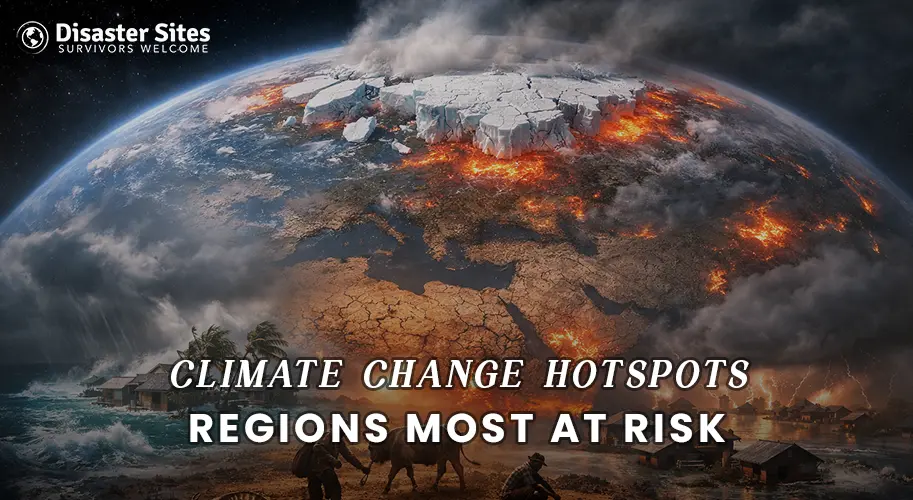
Climate change does not affect every region of the world equally. While global warming is a world crisis, there are also regions of the world that are experiencing far worse and more urgent effects. These areas are known as climate change hotspots, those being areas where man and ecosystem are under a very serious risk from global change at an exceptionally fast pace due to temperature elevation, extreme weather, and environmental stressors.
Finding these hotspots is critically important because it allows us to use our resources for the places where urgent action is needed. The threats are very diverse, from melting Arctic ice to flooding in South Asia, to rising seas threatening to swallow an island nation, and are bound in an area of geography. It matters what is at risk. Knowing what are the most exposed areas will help channel the attention, resources, and policies globally towards protecting people and places facing the brunt of the climate crisis today.
A climate change hotspot is a geographical area that is extremely exposed to the consequences of global warming. This is where environmental changes happen faster and hit harder, than in other areas. Hotspots can be identified by geography, population and economics making it difficult to adapt.
Hotspots may exist because of:
In short, hotspots are not a geographical claim concerning where climate change exists, but a claim about where the harms to people, nature and economic activity are most severe.
Hotspots are regions where disasters hit harder, faster, and more frequently. For a breakdown of the main causes of natural calamities worldwide, see Natural Calamities: A Detailed Overview of Their Causes and Consequences.
The Arctic is warming faster than literally anywhere else on the planet, and nearly four times faster than the global average. Ice dependent species like polar bears and seals are becoming increasingly unreliable due to melting glaciers and sea ice. This is not simply a problem for wildlife in the polar region, it is endangering millions, by raising sea levels. Now, agents of change in the Arctic have global impacts on coastlines worldwide.
The communities that are encountering these issues in the Arctic including Indigenous communities are placed in vulnerable circumstances. Thawing permafrost threatens their home, and impacts roads and other infrastructure that enhance their livelihoods. Thawing permafrost has also adjusted conventional means of food acquisition (hunting and fishing) which maintains the regulated behavior and structures that have not changed much in generations.
Climate change is a threat to small island countries like Maldives, Tuvalu and Kiribati. Rising sea levels are destroying coast lines, saline intrusion is replacing fresh water with sea water, and in some cases, entire countries are disappearing off the face of the earth. Many of these islanders would say climate change is not a disaster of the future... It is now.
All of these islands are incurring ongoing casualties due to flooding, strong cyclones, and significant coastal erosion. Leaving communities with a few safe or available spaces left for peace. The danger isn't just real estate, either. There's value in cultural loss. Should their islands disappear, people of these countries would lose their homes and homelands, more importantly, those very dependent on their national identity might be wiped away into oblivion.
Small island countries have been arguably the loudest, screaming in international climate negotiations because they find themselves in a battle for survival against those forces beyond their control.
Small island nations are already fighting for survival against rising seas and stronger storms. Learn how floods and landslides devastate communities in real time in Japan’s Deadly Floods and Landslides in July 2025: A Wake-Up Call for Climate Preparedness.
Climate change, the biggest challenge for global existence, has posed a serious threat in Sub Saharan Africa, where millions of people depend on small scale farming and fishing to make a living. Increasing temperatures, shifting weather patterns, and extended dry seasons have faced the region into vulnerability. Thus, agriculture and livestock have been hit hard, affecting food sources, demanding lower income, and consequently mounting hunger.
Desertification is also occurring in parts of Africa, leading to once fertile land becoming dry and unusable soil. Communities are displaced looking for water and resources that at times leads to conflict over limited resources. In every one of these situations, children and old people are at the greatest risk, who experience the most hardships related to malnutrition or heat related illness.
Rising temperatures and drought in Africa are worsening hunger and instability. For a recent look at how these threats are already unfolding, read Climate Crisis in Africa 2025 - Floods, Heatwaves, and Food Crisis.
Identifying which areas are most at risk enables us to see where urgent action is of necessity. Saving millions of lives will be possible by protecting vulnerable populations and working on adapting to the impacts of climate change along with diminishing emission of greenhouse gases. These protective measures will not just be important but also by then, they will have become urgent.
The present form of the life of the planet will depend on aforementioned aspects talking about Duo activeness and collective response.

“To assist disaster survivors by providing a source for them to come together in time of need, to aid in the listing of events, information and other forms of assistance, and continuing support through the recovery process.”

Share this page with your family and friends.